5/19/11

Meanwhile, in the Basement....

While the outdoor system is cycling, I’m continuing to grow indoors. I have a few rainbow chard plants that are now growing tremendously. I’ve also started some sweet peppers and heirloom tomato seedlings that I plan to transplant into the outdoor system. So far the tomatoes are growing very well, at about five inches tall. At over a year old, the pepper seeds delayed germination; however, they finally sprouted and now stand at half an inch tall. The system has many fewer plants than it can support currently: nitrate is about 30ppm at least. I plan to put this nitrate rich water into the outdoor system to kick start it for the transplants.


Rainbow Chard 5/17/2011

Rainbow Chard with Tomato and Pepper Seedlings 5/17/2011


Outdoor System Launch 2011!

In the first week of May I completed the initial setup of my outdoor flood and drain aquaponics operation. I grew outside for the first time last year, and I’ve made substantial alterations to the system design based on my experience (click for diagram of old system). This year, I’ve replaced my old shallow, clear plastic grow beds with 55 gallon blue plastic barrels cut in half lengthwise. I’ve also replaced the ¾ inch gravel with ¾ inch expanded shale (from Rob Torcellini of Bigelow Brook Farm). Lastly, I’ve installed an autosiphon to flood and drain the grow beds, based upon the design from Affnan.
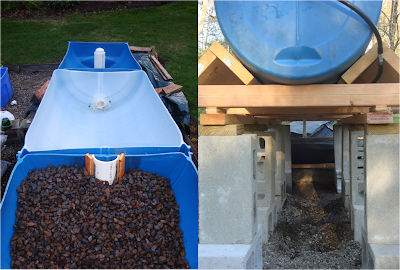
Grow bed with expanded shale and autosiphon viewed from above (left) and below (right)
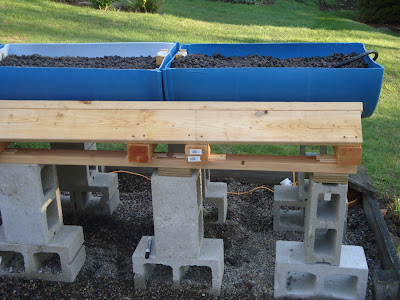
Grow bed with wood frame and cement block stand
The updates to the system should prove fruitful. The grow beds are now a 12” deep in the middle, about three to four times deeper than last year. This will allow for much longer roots, more surface area to absorb nutrients and water, better insulation from the heat, and greatly increased area for nitrifying bacteria growth. I’ve switched to expanded shale for its light weight, moderate price, and pH neutrality. The autosiphon provides me with a failsafe method to flood and drain the grow bed – no moving parts and no possibility to overflow.
Still using the 160 gallon plastic fish pond, I’ve set up three barrel halves for a roughly 1:1 ratio of tank to grow bed volume. The barrels are all connected with 2” PVC pipe and use one autosiphon at the opposite end at which the water will enter from the pump. Hopefully one siphon will be sufficient for the system.
Given the short growing season in New England, plus the time delay needed to cycle the system to build up nitrifying bacteria, I’ve decided to try a fishless cycle. Without fish, I can put pure ammonia into the system and achieve much higher levels of ammonia than the fish could tolerate. With ample ammonia, I hope that the nitrifying bacteria will establish and multiply relatively fast. Unfortunately, the one key ingredient the bacteria need – heat – is seriously lacking this month. The bacteria flourish in 75-85oF temperatures, and May has delivered cold, wet weather.
Meanwhile the fish are happy inside feeding some chard and tomato and pepper seedlings! See next post for more on that. Also, there are three more barrel halves that I plan to turn into additional grow beds soon.

5/1/11

Winter Growing Season

The winter growing season was a smash! The lettuce did quite well, and I harvested about eight salads that fed four to six people each from February through April, about two-and-a-half salads per month! The first six of those salads came from the clay pebble bed that had densely planted seeds. The dense planting stimulated quick, vertical growth. It also ensured that plants did not grow woody stems, keeping the growing tip low, just above the surface. I harvested this like mowing a lawn,, cutting at about 2” high straight across. The plants responded well! For the first two months I harvested at a staggered pace, which kept the demand for nutrients relatively constant because some plants were in the high demand regrowth stage as others grew slowly near full size.

Mixed lettuce in clay pebble bed on 2/18/2011 (top) and 3/26/2011 (bottom). 
Gray coloration on bottom is due to grow light being off. Note that the gravel 
grow bed seen in upper right of both pictures has significantly smaller plants.
Meanwhile, the gravel grow bed which had plants spaced about 6” apart, as recommended on the seed packet, grew very slowly, so I did not harvest until late March. The plants did bush out nicely, each producing far more lettuce per plant than the dense plantings of the clay bed. The bushy lettuce led to woody stems and larger leaves, which I found could only get a few harvests per plant before the leaves got too tough or bitter (lots of white sap in them). 


Gravel grow bed on 4/28/2011 before the last harvest.

Conclusion: unless I need pretty heads of lettuce, I should plant the seeds dense and harvest often.

And what about the other plants in the system? Well, the chard...

4/30/11

Water Wheel Conclusion

In February, I began testing a prototype of a water wheel biological filter (see original post describing wheel here). After about a month and a half of testing, I found that it provided decent biological filtration but that it had mechanical flaws. I’ve since decided to retire the project, at least for the summer season. Here’s the scoop:

My neighbor and I built the wheel from ¼” thick, untreated plywood. While pressure treated or stained wood would have resisted rot and water absorption, I did not want to risk chemicals leaching into the water. We also experimented with some Plexiglas, which proved too difficult to cut as it fractured easily.

The wheel was connected to two screen-covered drums by PVC pipe, the pipe was supported by a wooden dowel, and the dowel was suspended by strings at each end. As you can see in the video on the original post the wheel turned well initially; however, after a few days, the wheel noticeable slowed down, eventually coming to a stop. I found that the dowel bowed due to the weight, creating extra friction, so I replaced the dowel with a metal pipe. Nevertheless, after a while the wheel slowed to a stop, too. The wood had absorbed water which weighed it down and it’s possible that bacteria growth also added to the weight. Interestingly the wood did not warp noticeably, but after the trial period, it was covered in little black dots of mold – probably not good for water or our air quality. 

Black mold growing on water wheel paddles (left) and screen drum (right)
Meanwhile, I was designing my flood and drain and deep flow technique (DFT) systems* for the outdoor season this summer. The DFT would use the water wheel as its biofilter*. During my research, I learned...

2/11/11

Winter Growing

After some experimenting with grow bed media in the early winter, I planted my indoor crop of lettuce and rainbow chard in mid-January. After about four weeks the plants look quite healthy. All seeds germinated in the expanded clay bed, and I then transplanted a few into the gravel bed. I've given the lettuce in the gravel bed plenty of space, and I'm curious to see how differently the plants grow in the dense and spaced scenarios.
   
Expanded clay bed 2/3/2011
   
Expanded clay bed 2/9/2011

Gravel bed 2/9/11
The conditions in the water are not ideal right now: while there is plenty of nitrate (plant food), the pH is about 8 and the temperature is about 62-65 oF.

A pH of 7 or just below is ideal in aquapaonics. Plants absorb the most nutrients in slightly acidic conditions (pH < 7)  while fish prefer it slightly basic(pH > 7). So we compromise and try to make the water pH neutral (pH 7). The nitrificaiton process (turning fish waste into plant food) naturally lowers the pH, so the fact that mine is above 7 means other factors are at work. First, my gravel has lots of limestone in it, and the calcium it contains leaches into the water and raises the pH. Surprisingly, the clay pebbles also raise the pH, even though they are billed as pH neutral. I tested them by letting some clay pebbles sit in fresh tap water (pH 7) for a week, and they raised the pH up to 8 or 9. The plants are growing well now, but I'm going to experiment with adding some lemon juice to lower the pH over the next week.

As for the temperature, the nitrifying bacteria prefer water between 72-75 oF. At lower temperatures, their growth rate slows down significantly.  I could use water heaters, but they are very energy inefficient, so I'm trying my hand under cooler temps. The goldfish and lettuce, however, love the cold water. Currently, there is plenty of nitrate in the tanks, and I will monitor the tank to see if the bacteria are able to maintain sufficient levels as the plants near harvest stage.